BAGNOLI COLLECTIVE
This project reimagines an existing ground-floor market building in the town of Bagnoli as a new community anchor, a place where the town’s rich culture of informal public life can find a permanent home and space to grow.
Through site visits and observation, I discovered that locals had already claimed numerous open spaces across Bagnoli for activities such as street food, puppet theatre, performance, dancing, cinema, art and more. These events were lively and well attended but lacked proper infrastructure to support or expand their reach. Rather than introducing something entirely new, I aimed to recognise, unite and enhance what was already happening by offering dedicated, well-designed spaces for both formal and informal community use.
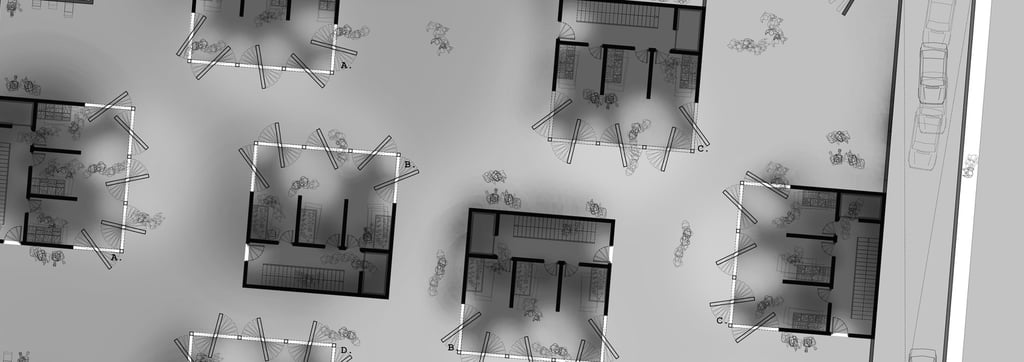
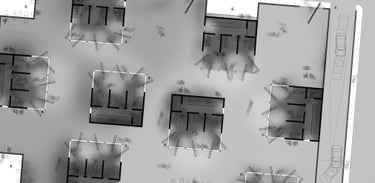
The chosen site, a large market hall located centrally near the station, parks and colleges, was already popular and well used. However, the building itself lacked character and meaningful outdoor space. My proposal was to demolish the existing structure and replace it with seven smaller square buildings. These new buildings would form a constellation of activity, with the ground floor entirely dedicated to the existing market. Pivoting façades would open wide during market hours, dissolving the boundaries between inside and outside and allowing the flow of people and life to move freely through the site.
Above the market, two additional floors accommodate a wide variety of public programmes. These include a community kitchen for shared meals and cooking lessons, a woodworking workshop, a quiet study area and library, a small cinema, an art gallery, an art studio, a lounge café and several flexible rooms left open for future uses defined by the community. A basement parking area improves accessibility, responding to local habits and encouraging visitation.
The open spaces formed between the seven buildings are intentionally left undefined. Rather than dictate their use, I chose to offer a blank canvas for the community to appropriate, shape and evolve over time. These in-between zones can host anything from workshops to festivals, gardens to murals. The project anticipates that the character of the site will shift throughout the day, welcoming spontaneous gathering as much as planned events.
Architecturally, the new buildings draw from Bagnoli’s colourful modernist context and industrial heritage. Designed as clean square concrete volumes finished with grey plaster, they remain modest in appearance to respect their surroundings while standing strong as a new civic presence.
Guided by principles of adaptability, community ownership and social resilience, this project seeks to give permanence to the informal spirit of Bagnoli by offering both structure and freedom, identity and openness.