PLAZA CEBADA
This project explores the transformation of the Cebada Market in Madrid by returning it to its original urban role as a vibrant, open square defined by transparency, community and fluid circulation.
Historically, Cebada was a large open square filled with merchant booths, a lively and successful marketplace at the heart of the city. Over time, the original open-air market was replaced first by a steel frame building with extensive glazing to protect visitors from the elements. However, this structure was later demolished due to safety concerns and replaced by a solid concrete building featuring six iconic domes inspired by local architectural heritage. While these domes have become a landmark, the new solid structure blocked visual and physical connections to the surrounding streets, creating an obstacle within an otherwise lively neighbourhood filled with shops, cafés and theatres.
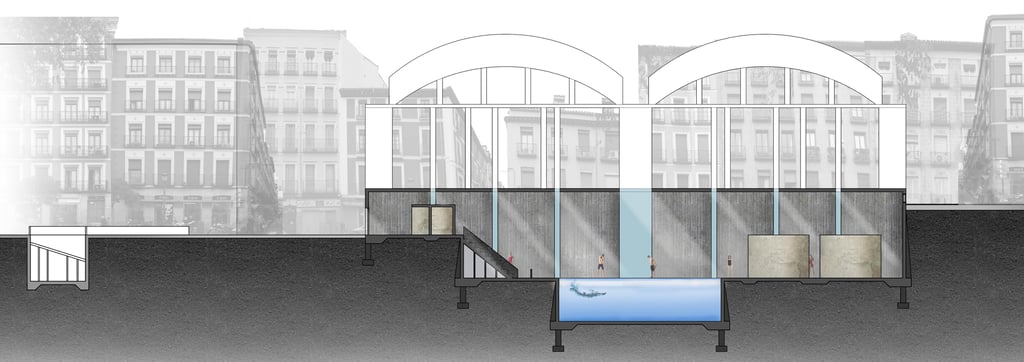
My proposal takes inspiration from famous nearby plazas such as Plaza Mayor and Plaza de la Villa, where the flow of people moves freely across open spaces. I aimed to restore that sense of openness by demolishing all interior floors and the enclosed building mass while preserving the six concrete domes for their shading and landmark qualities. This approach transforms the site back into an accessible square that encourages direct and intuitive pedestrian routes, connecting the busy surrounding streets.
The ground surface is paved throughout with traditional Madrid stone, extending the materiality of the neighbourhood into the square and strengthening its urban integration. Semi-permanent modular booths are introduced as the new market stalls. These booths unfold each morning to welcome merchants and visitors, then fold away in the evening to serve as storage or informal seating, and even small stages for creative activities. This design supports a dynamic and multifunctional marketplace that adapts to different uses throughout the day.
The site also includes an underground swimming centre, a facility that existed previously but had been abandoned and left in disrepair. Reviving this centre adds a valued community amenity that promotes health and social engagement year-round.
Importantly, the informal youth gathering space that had organically developed around the site is embraced and integrated into the design. During the day the youth mingle naturally with merchants and visitors, while at night the open square allows them to claim a stronger presence in the neighbourhood’s social life.
This project is guided by principles of inclusivity, community, and a human-centred approach. It seeks to bring back the Cebada site’s original spirit as a democratic and welcoming space for commerce, culture and everyday interaction, reconnecting people and the city through architecture and urban design.